
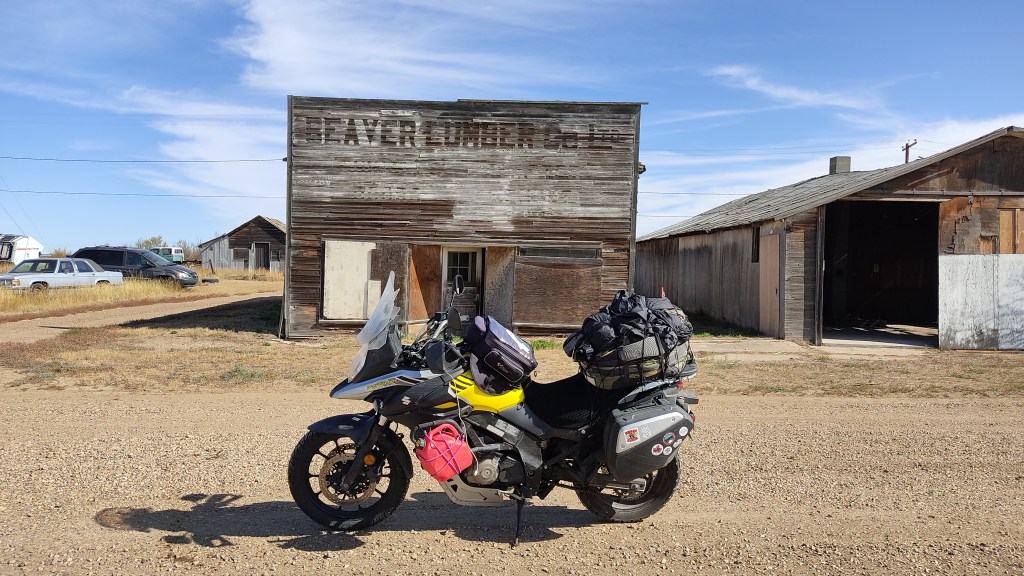
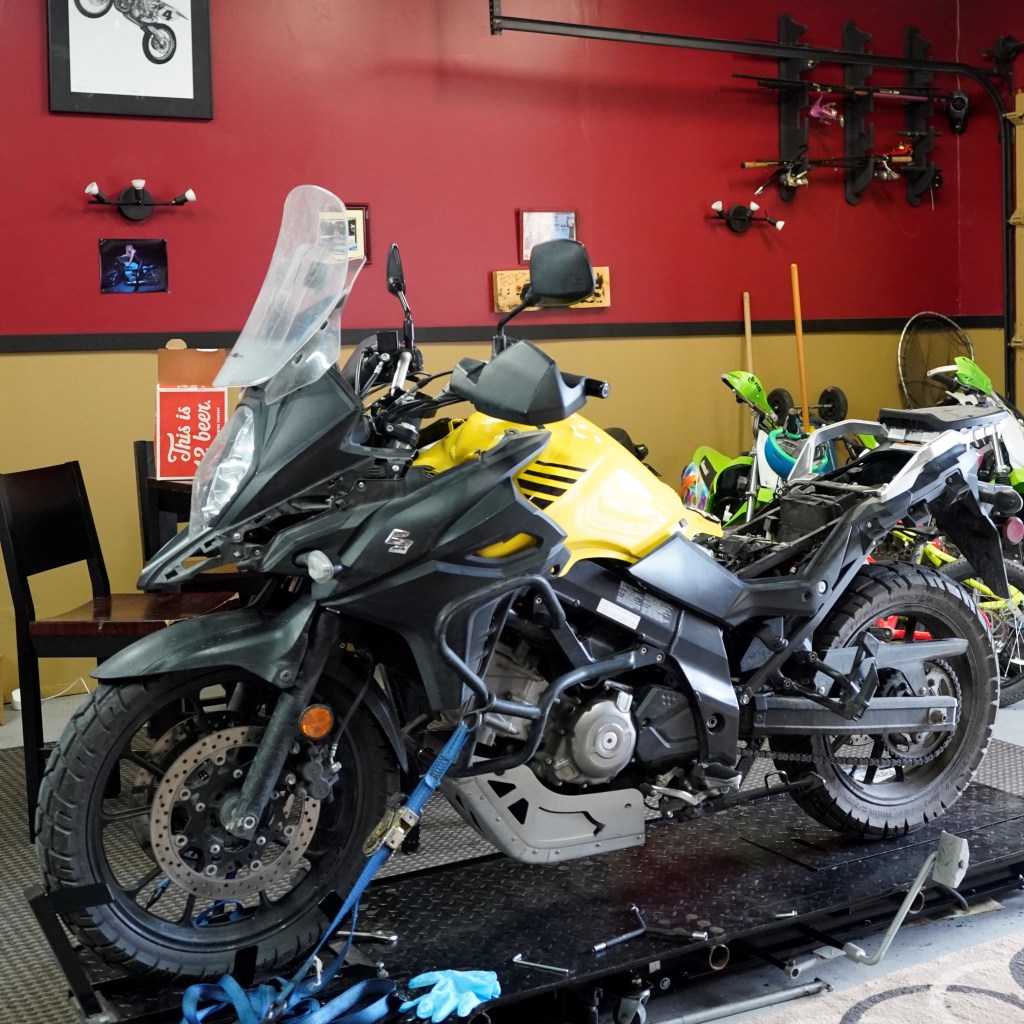
In June 2023, I chose to travel across Canada on a used 2017 Suzuki V-Strom 650 A, also known as the DL 650 A. After 5 months of sitting on the Aircool saddle and with Oxford heated grips, it’s time to analyze this model as objectively as possible.
As the choice of a motorcycle is subjective and depends on its primary use -long-distance travel in my case- I was motivated by several factors: versatility, technical specifications, reliability and repairs, price. Factors that suited my profile as a novice traveler. And thus a bike to match my profile.
Versatility and adaptability are key.
What better way to set off on an adventure than with an adventure-class motorcycle? Until 2023, the Suzuki V-Strom came in two engine sizes, 650cc and 1050cc. In the spring, the Japanese brand released an in-between model, the Suzuki V-Strom 800DE, as well as its new big cube, the Suzuki V-Strom 1050DE. It was too late to consider this option, and the 650 was a good experience for my debut on a dual-sport bike. With 70% cobbled roads planned, and not always in good condition, I needed a bike capable of venturing everywhere, without difficulty and without requiring a concrete back and arms. The Suzuki V-Strom 650 A proved to be almost as maneuverable on-road as it was off… with the right tires! Let me explain.

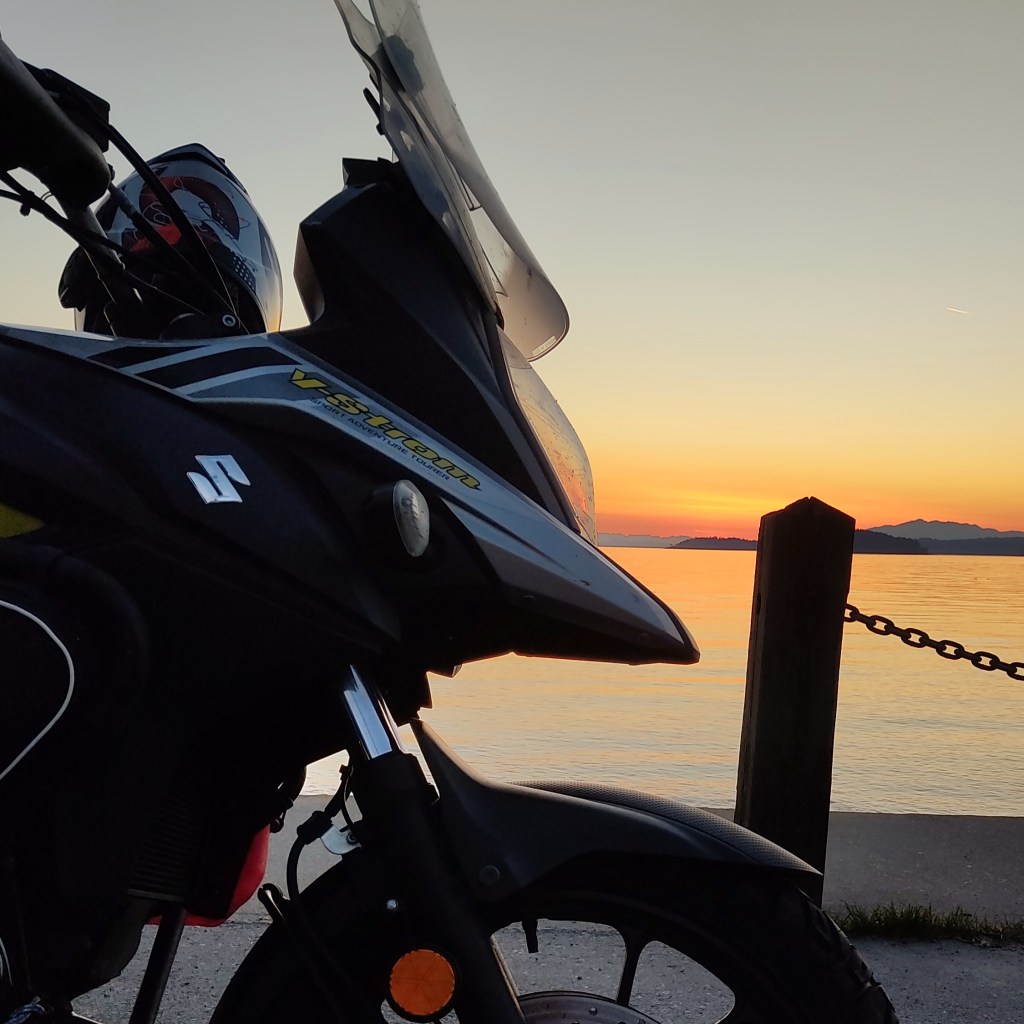
Here, I opted for the A version rather than the XT, which, to put it simply, wasn’t the most adventurous version, as could be seen, for example, in the wheel assembly. Alloy rims and a 19″ front wheel for mine, versus spoke rims and a 21″ front wheel for the XT, the adventure trail model. A wider front wheel would provide greater stability when tackling loose, slippery ground. As for spoke rims, they make it easier to negotiate any obstacles that may get in your way. Well, in your wheel. And they offer more cushioning, unlike sticks, which could break if you hit a pothole with too much speed, for example.
But it’s possible to get away with taking an adventure bike with stick wheels over really rough terrain. To have the most fun while maximizing safety and sensations, you can play around with the tires. The original Bridgestone Battle Wing tires were 80/20 street tires. 80% of the time, the bike is on the road, 20% off-road, and more likely on forest or country roads, for a short distance. Don’t go deep into the Sahara or the heart of the tundra either.
I had no problem with these tires when tackling the under-construction roads of Quebec and Ontario, where gravel is superimposed on oily concrete. However, the lack of perfect lustre on dirt roads soon convinced me to switch to something more aggressive. That’s where I started with my first adventure tires, Korean Shinko 705, which served me very well during my 15,000km learning phase. Then, durability and better adaptability to rough terrain led me to the famous Dunlop Trailmax Mission tires. But this article is not intended to be yet another tire comparison. There are plenty of them, offered by reliable sites such as moto-station.com or motoplanete.com, and even two forums dedicated to the V-Strom, in both English and French!
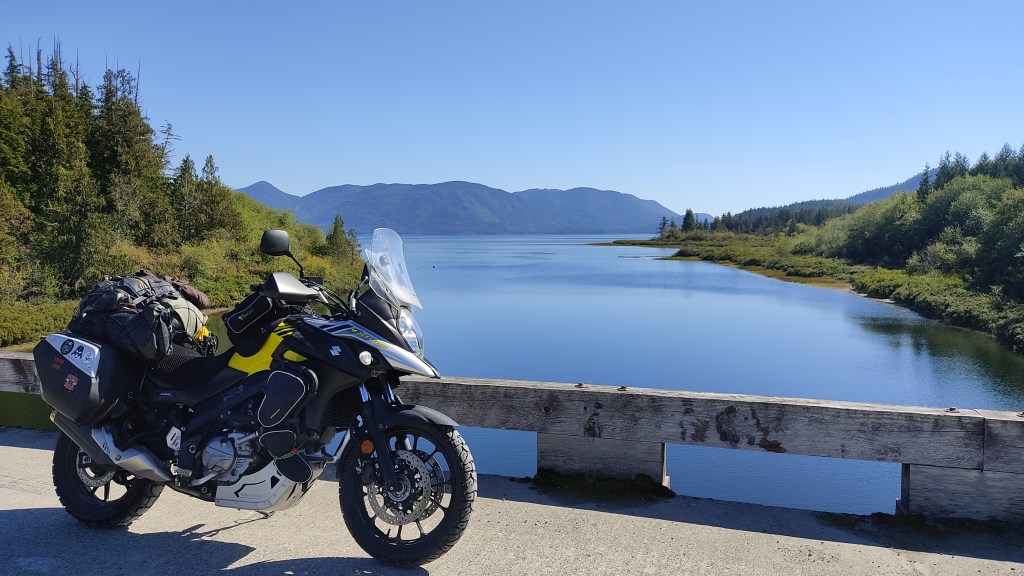
With the addition of some equipment by the previous owner, I almost had a trail version capable of coping with many difficult weather and road conditions. Aluminum engine mount, adjustable Givi windscreen, Oxford heated grips, right down to a seat covered by the aircool system. I had no time to regret the absence of a center stand. With its options, the bike was a few kilos heavier than the 216kg advertised by the manufacturer. As we all know, weight can make all the difference, especially if you have to pick up your sweet bike, carelessly lying on the ground, in the middle of a nap.
On the engine side, the 4-stroke twin is smooth enough to enjoy long stretches of freeway when you have no choice but to go for it, and responsive enough to have fun on the gravel track.
After 30,000 kilometers of use, this model’s versatility and reliability, even in sand, mud, ruts and potholes, convinced me I’d made the right choice. With a low center of gravity for a trail bike, even for the original, unlowered model (seat height 830mm – 825mm for mine), there’s none of that feeling of loss of control that can happen in certain situations, on unstable terrain for example. The fuel tank doesn’t take up too much space, and smaller riders like me will appreciate not feeling like they’re driving a tank. Once upright on the foot-pegs, this feeling of control is reinforced, and the V-Strom 650 responds perfectly to hip thrusts and handles emergency braking without flinching – the ABS playing its part here, of course. However, traction was a major issue off-road, and I have to admit I didn’t feel any real difference between the manufacturer’s traction control modes 0,1 and 2. I was able to get out of certain situations, namely climbing off-road passes or riding in sand, thanks to my confidence in the Suzuki’s reactions and my ability not to overestimate myself.
Robustness and reliability
The Suzuki V-Strom 650 is renowned for its longevity. Engine longevity, component longevity and maintenance equivalent to a healthy ride. For a trip where the lack of mechanical skills was one of the major weaknesses, I felt that the bike I had chosen should require a minimum of repair work. If so, the availability of parts was a major advantage. The model has been on the market for over 10 years, and many parts have not been modified. This is particularly true of its oil filter, as I found out when I changed it myself in Prince George, taking advantage of the fact that my host, Kelly, owned a 2011 V-Strom 650 and several filters that were still new. But I was also able to see just how popular this model is by the number of motorcyclists I came across, or even when special orders were placed, such as fork seals. While I was expecting to wait several weeks, it took 48 hours for the Suzuki dealership I contacted to help me out.
After 30,000 kilometers of use, the Suzuki’s sturdiness was confirmed, and I understood the use of the word « tank » by some owners of this model. If some of them are to be believed, I can even expect to exceed 100,000 kilometers without any major problems.
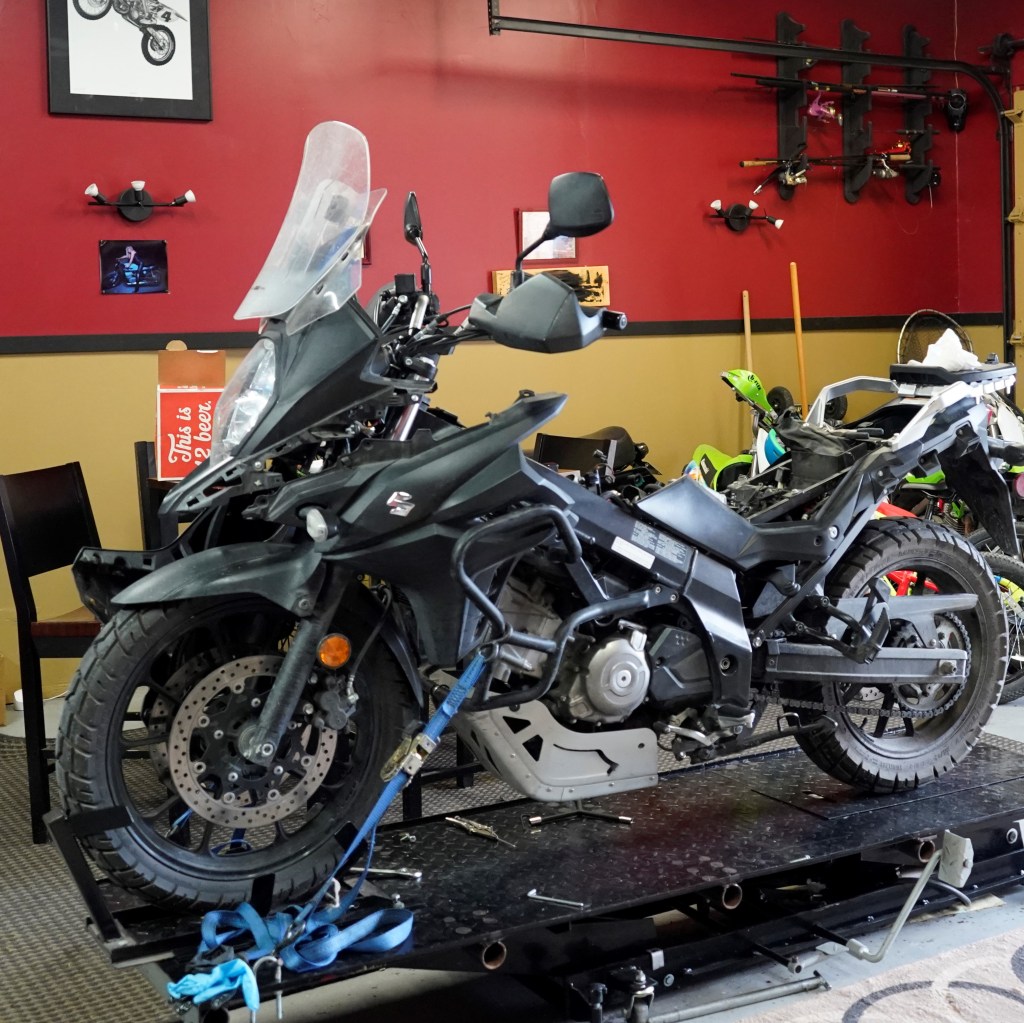
Except an injector issue that was relatively sensitive to the quality of the fuel used, causing the engine warning light to appear five times throughout the whole trip, and the loss of my mudguard due to too many potholes in Montreal, I found the Suzuki DL V-Strom 650 A to be a reliable motorcycle, whatever the terrain or the number of daily kilometers ridden, and one whose basic maintenance could easily be carried out: oil and filter; low and high beam bulbs; tire; battery; among others. However, some improvements could make it easier for users to maintain their motorcycles, especially when traveling. To access the air filter and various valves, the fuel tank has to be removed. I’ll leave you to imagine the strength and agility required when you’ve just filled it to the top, i.e. 20 liters.
Fuel consumption and price
Suzuki is well aware of the growing popularity of adventure, dual-sport and trail bikes. In 2023, the brand launched an 800DE model and 2024 will see new models too, further establishing itself as a serious contender in this segment. For those for whom buying new is unthinkable, the second-hand market is still going strong. Overall, a Suzuki V-Strom 650 A (or XT) produced between 2016 and 2020 can be found for between 7,000 Canadian dollars (4,800 euros) and 10,500 Canadian dollars (7,500 euros) with an average mileage of between 30,000km and 60,000km, including various equipment and luggage.
In terms of average fuel consumption, I rarely exceeded 4.7L per 100 kilometers, despite a heavy load and all roads covered. Robust, economical to buy and run, the Suzuki V-Strom 650 proved to be an excellent first adventure bike that I can’t wait to push even further to its limits. Over time and in the field.
For French version, click here.

 Julia on a bike
Répondre à Après 5 mois de voyage, mon avis sur la Suzuki V-strom 650 – Julia on a bike Annuler la réponse.