
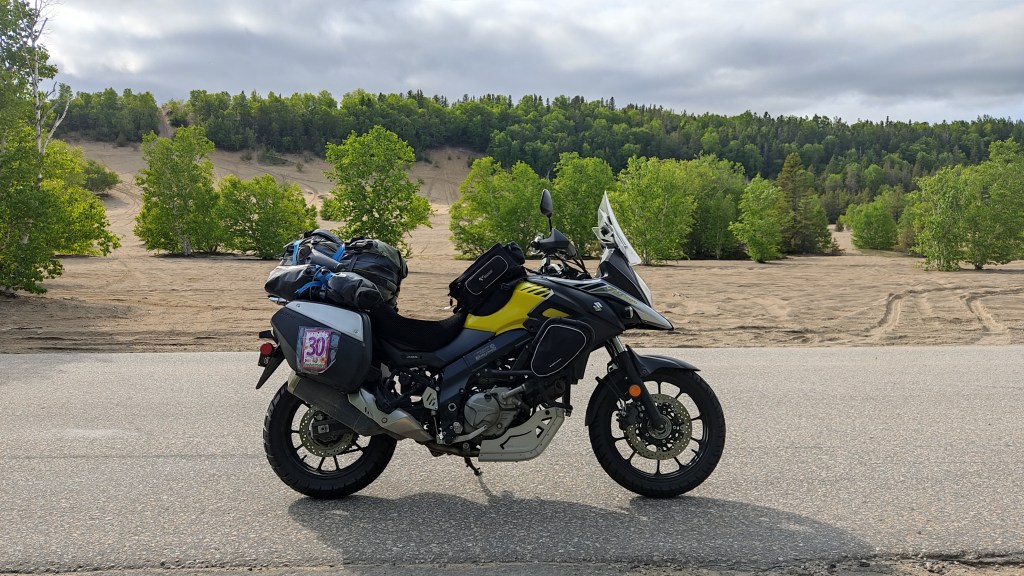
A roadtrip is not only getting amazed by wonderful landscapes and the freedom which goes along. It is also an opportunity to discover a culture ; a history ; whether told by the people who live there, or by the monuments still standing and maintained, or even by the geological formations that have been preserved and documented. Canada, as we know it today, is considered a young country. I heard it many times. Yet this land was shaped thousands of years ago and inhabited by different peoples down the ages. This is what I discovered after 30,000 kilometers of motorcycling. In this second episod of our History & Culture of Canada series, here are a few places you can visit to discover Quebec in a different way.
Quebec is Canada’s largest province, and second in population after Ontario, with over 8.6 million inhabitants. It’s one of the oldest European colonies in North America, and its capital, Quebec City, was founded on July 3, 1608 by French navigator Samuel de Champlain.
Fun fact: Don’t look for English road signs – there aren’t any. Although Canada is a bilingual country, English and French, Quebec is the only province whose official language is French. And there’s no shortage of English-speaking anecdotes about requests for information or directions… which are all too often non-existent! Sorry, but if you want to perfect your command of Shakespeare’s language, forget this province!
Manic 5, Uapshika station and Fermont wall: a route 389 full of surprises
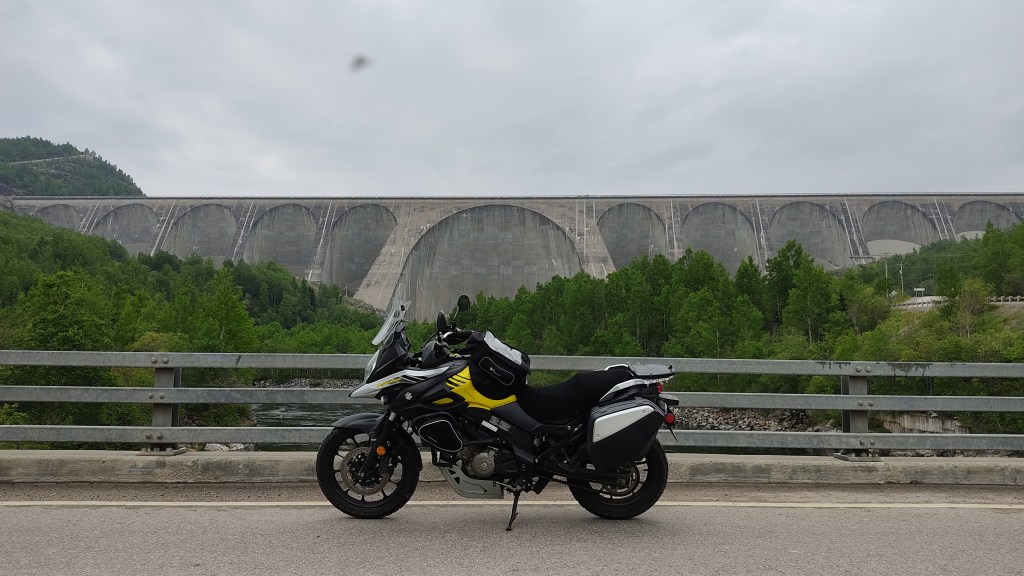
On Quebec’s north coast, more than 2h30 from Baie-Comeau, from the heights of Route 389, you can see the Manic-5 hydroelectric power station and the Daniel Johnson dam. A true masterpiece and the pride of Québec, built between 1962 and 1968, it is the world’s largest multiple-arch buttress dam. When you look at it from below, you almost feel dizzy. « The Statue of Liberty could fit inside, » I was told. So, myth or legend? I’ll leave it to you to find out. The Manic 5 power station is one of the most powerful in the province, and indeed in the country. Hydro-Québec, which operates the site, offers free tours between mid-May and the end of August. Tours last two hours. You’ll enter the bowels of the site and then get a bird’s-eye view of the dam. Reservations are essential.
120 kilometers further on, including 100 kilometers on dusty gravel in dry weather, you can stop at the Uapshika station. It’s an unusual place. On the shores of Lake Manicouagan, in the middle of the Monts Groulx, it’s reminiscent of both a huge two-storey gîte and a summer camp for adults. Half the staff are Innu, and tourists mix with scientists who live here year-round. In fact, the station, co-managed by the Conseil des Innus de Pessamit and the Manicouagan-Uapshika World Biosphere Reserve, serves as a base camp for those who come to study this UNESCO World Heritage Site. The Uapshika resort is multicultural, with state-of-the-art infrastructures and a strong emphasis on eco-tourism. Accessible in summer and winter alike, it promises a unique experience in the heart of the Monts Groulx. And if you’re a gourmet, you’ll love the meals prepared by the Chef!
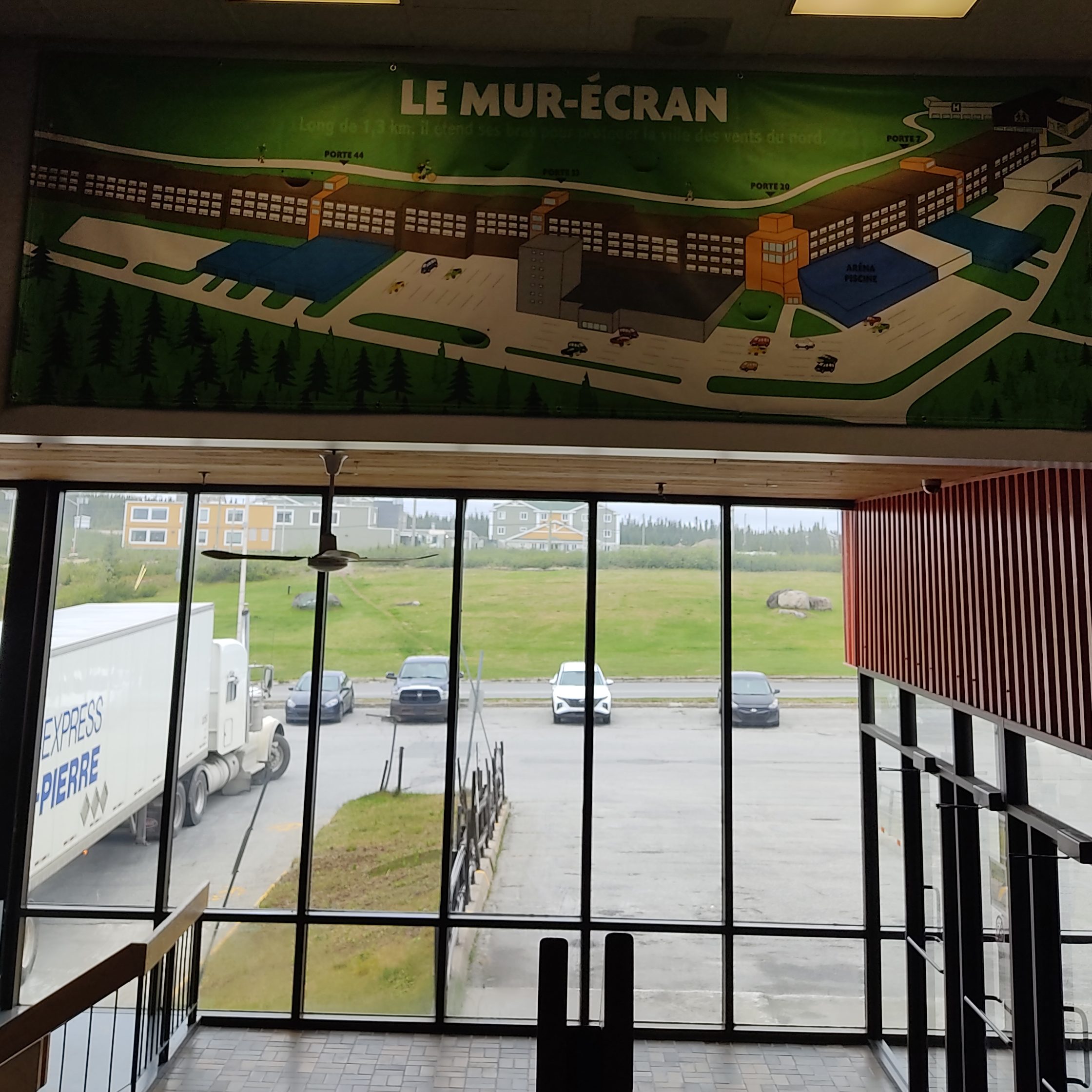
Once you reach the end of Route 389, north of the 53rd parallel and on the border with Newfoundland and Labrador, you’ll discover the town of Fermont. A little linguistics? The town takes its name from the iron ore found and mined on Mount Wright, some 25 km to the west. Fermont was built in the 1970s to house workers who came to exploit the mine for Québec Cartier, which became ArcelorMittal Mines Canada in 2008. Most of the housing belongs to the company and is rented to employees for the duration of their contract, which can last from several months to several years. A « Shield Wall » has been built to protect the population from the freezing temperatures and winds that hit the city in winter. It is 1.3 kilometers long, takes the shape of an arrowhead and is 20 meters high. The building houses all the essential services: over 350 homes, a swimming pool, a town hall, a supermarket, several restaurants and stores, a post office and even a school.
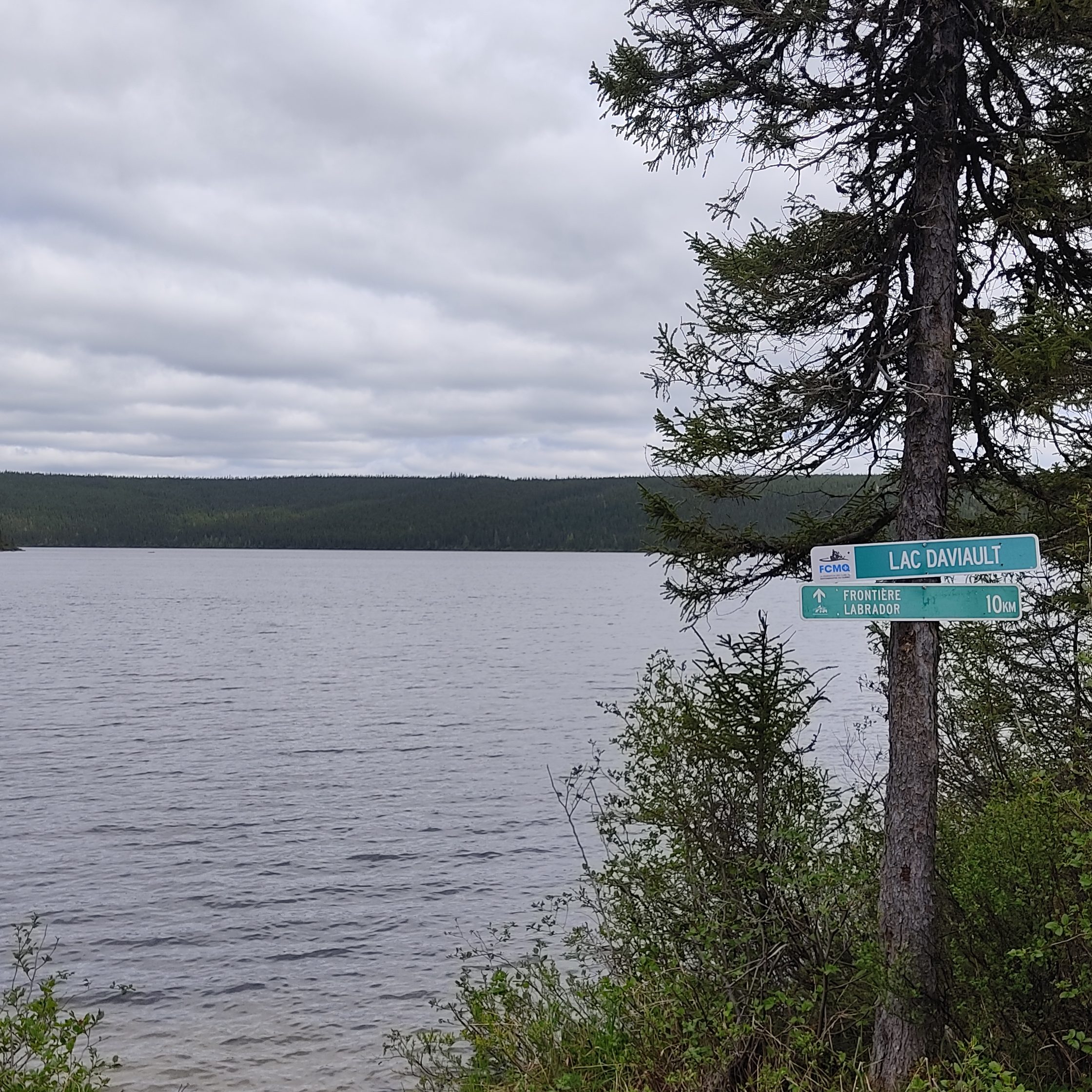
Despite its subarctic climate, Fermont offers breathtaking scenery, surrounded by Monts Daviault and Severson, where the northern lights are not uncommon and outdoor activities are a daily treat. From the town, you’ll have easy access to Labrador City, the capital of Labrador. It’s the gateway to the province of Newfoundland and Labrador, and the continuation of the famous « Expedition 51 »
The Saguenay Fjord, a geological formation not to be missed
When we hear the word fjord, we immediately think of Norway or Iceland, rarely Canada. Or Quebec. For it was here that I observed a fjord for the first time, and not the least! 100 kilometers long, two kilometers wide and 400-meter-high cliffs: it’s a feast for the eyes, whether it’s snowing, windy or a mild summer’s day. The fjord is so deep that it even attracts whales to its mouth. With a bit of luck, you can observe them from the shore, or from the boat or zodiac on an excursion. Cruises are part of the region’s tourist offer from May to October. What’s more, it’s a great opportunity to stop off and visit Tadoussac. My advice: don’t stop at the town, go and discover the Dunes!
You can visit the Saguenay Fjord from above, by seaplane. It’s a great way to get a different perspective, but not for everyone. By car, motorcycle or bicycle: the 300-kilometre loop from Saguenay along routes 170 and 172 is a real beauty. Don’t hesitate to leave these two routes to admire the fjord from various vantage points. On the south shore, you can hike near Montagne Blanche or observe Chute à Vidas. On the north shore, don’t miss the Pourvoirie du Cap au Lesle outfitter, where you might want to extend your break and spend the night. The view of the Saguenay River and fjord is well worth it! Not to mention the quality of the food on offer.
Sainte-Rose-du-nord is also a must-see village, considered one of the most beautiful in Quebec. And if you’d like to explore on foot and for less than three hours, take the Le Fjord trail, in the Baie Sainte-Marguerite area. An easy and instructive hike, with superb views of the fjord.
Gaspésie, but not just for Percé Rock
When you’re in France and you think of a stay, vacation or immigration to Quebec, the first thing that comes to mind is Montreal. Then Quebec City. Then Gaspésie. So much for the top 3. So, if the previous two paragraphs have given you an idea of some lesser-known corners of the province that are well worth a visit, let’s move on to Gaspésie. The region is a tourist destination, and not just for Percé Rock – even if too many tourists are capable of standing in line, sometimes for days on end, to take THE photo of the rock, illuminated by the rising sun. When you come to Gaspésie, you want one thing: fresh air and a diversity of outdoor activities. We’ll say « outdoor » because that’s what we mean. Here, you can hike to your heart’s content. Parc national Jacques Cartier, Parc national de Forillon, Parc régional du Mont Saint-Joseph, I could go on listing them one by one, but that might not captivate you.
The whole territory is off the beaten track. Of course, a complete tour of the Gaspé Peninsula, via routes 132 and 138, and even cutting across 198 or 299, is a must for roadtrip lovers. However, with a network of hiking trails stretching for hundreds of kilometers, between sea, mountains and rivers, where every mountain will make you want to pitch your tent for the rest of the year; Gaspésie is a paradise. And it’s even here, on the Gaspé Peninsula, that North America’s first GR (GR1) was inaugurated. That was in 2015. It’s the SIA, the International Appalachian Trail, 650 kilometers long. If you’re interested in this GR or would like more information, rest assured that the Tourisme Gaspésie website has all the resources you need. But keep your eyes peeled for the world’s largest colony of Northern Gannets right here. If you too have had the opportunity to visit Perros-Guirec and enjoy the discovery of the 7 islands, then you’ve probably already seen the only colony in France. Well done! In addition to birdwatching, you’ll probably be lucky enough to see a moose, an animal feared by all motorists, but whose meat is highly prized and hunting is almost a national sport. And let’s not forget the whales, which you can’t get enough of, everywhere and at all times.
But what also makes Gaspésie so special is the draught. Yes, I’m talking about beer. Quebec has acquired a surprising reputation for its countless microbreweries. The Gaspé Peninsula is no exception. It’s impossible to miss Pit Caribou‘s craft beers at their pub-restaurant in Percé, or at the micro-distillery in L’Anse-à-Beaufils. I’ve even been told that you can bring your own barbecue or picnic, as long as you eat on site, of course. But if you like a rare brew, my advice is this: go to the Auval brewery! Production is limited, and locals and tourists alike snap up every bottle. In Carleton-sur-Mer, I also discovered Le Naufrageur microbrewery. The founders chose to diversify by offering a local experience for our palates: after the restaurant and microbrewery, they bought a bakery and canteen. With fresh, seasonal and sometimes organic products, we’re discovering Quebec in a whole new way. Did you really think we only ate poutine around here? Sorry, par icitte*.
| How do I get to Quebec? By land: Whether you take the Trans-Canada or the secondary roads, Quebec’s road network is highly developed, and all roads are paved. However, if you want to go beyond the Manic 5 reservoir on Route 389, there are 150 kilometers of gravel road (a mixture of pebbles and sand) before you reach Fermont. The other most popular route is Route 138, along the north shore of the St. Lawrence. If you feel like going to the end of Route 138 to visit Kegaska, 40 kilometers of unpaved road also await you. But from all accounts, it’s one of the most beautiful roadtrips you’ll ever make. By air: Montreal and Quebec City each have their own airport, serving thousands of tourists and workers, as well as numerous cities around the world. By rail: Via rail always offers an exceptional route from Toronto (Ontario) to Vancouver (British Columbia) and from Montreal to Halifax (Nova Scotia). A carpool or train can get you to Toronto in just a few hours from Montreal or Quebec City. How to get around? On foot, by bike, motorcycle or car. Quebec’s network of bicycle paths is expanding at a rapid pace. As summer approaches, or in spring for the more adventurous, you can easily enjoy the various regions of the province. If you prefer motorized two- or four-wheelers, remember to book in advance for the high season. Your French driving license will suffice for most rental services. And don’t forget, the speed limit on freeways is 110 km/h, and 90 km/h on secondary roads. To make sure you don’t miss a thing and prepare for your visit, the Bonjour Québec website is full of advice. You can also order several paper guides in advance. |
 Julia on a bike
Laisser un commentaire